
Exam - 6 Math: Topic: Number System, Simplification, Problems on Number,HCF& LCM
১) How many prime numbers are less than 70?
- 16
- 20
- 19
- 18
Question: How many prime numbers are less than 70?
Solution:
Prime numbers less than 70 are, 2, 3, 5, 7, 11, 13, 17, 19, 23, 29, 31, 37, 41, 43, 47, 53, 59, 61, 67.
Hence, the number of prime numbers less than 70 is 19
মৌলিক সংখ্যা: ১-এর চেয়ে বড় যে সকল স্বাভাবিক সংখ্যাকে ১ এবং ঐ সংখ্যা ব্যতীত অন্য কোনো স্বাভাবিক সংখ্যা দ্বারা নিঃশেষে ভাগ করা যায় না তাকে মৌলিক সংখ্যা বলে।
২) Find the value of (125 + 216) - (1750/53) + 15 = ?
- 342
- 329
- 344
- 392
Question: Find the value of (125 + 216) - (1750/53) + 15 = ?
Solution:
Given that,
(125 + 216) - (1750/53) + 15
= (341) - (1750/125) + 15
= 341 - 14 + 15
= 341 + 1
= 342
৩) The LCM and HCF of two numbers are 168 and 6 respectively. If one of the numbers is 24, find the other.
- 52
- 48
- 36
- 42
Question: The LCM and HCF of two numbers are 168 and 6 respectively. If one of the numbers is 24, find the other.
Solution:
Given that,
LCM and HCF of two numbers are 168 and 6
Let, the second number be x.
We know that,
product of two numbers = L.C.M × H.C.F of those numbers
⇒ 24 × x = 168 × 6
⇒ x = 1008/24
∴ x = 42
So, the other number is 42.
৪) When 43 is divided by x, the remainder is x - 5. If x is a natural number, how many solutions will x have?
- 3
- 6
- 5
- None of the above
Question: When 43 is divided by x, the remainder is x - 5. If x is a natural number, how many solutions will x have?
Solution:
Given that,
43 is divided by x, remainder is x - 5
And x is a natural number.
Now,
43 = kx + (x - 5) where k is an integer.
⇒ 43 = kx + x - 5
⇒ 43 = x(k + 1) - 5
⇒ x(k + 1) = 48
∴ x is a factor of 48.
Remainder r = x - 5 must be ≥ 0
⇒ x - 5 ≥ 0
⇒ x ≥ 5
Factors of 48 are 1, 2, 3, 4, 6, 8, 12, 16, 24, 48.
Since x is a natural number and x - 5 must be a remainder,
Valid factors of 48 greater than 5 are 6, 8, 12, 16, 24, 48.
There are 6 factors.
৫) What is the value of [26 + {42(23 - 20) + 2 - {2(5 × 80 - 100)} + 16 - 4}] = ?
- 434
- - 436
- 430
- - 434
Question: What is the value of [26 + {42(23 - 20) + 2 - {2(5 × 80 - 100)} + 16 - 4}] = ?
Solution:
Given that,
[26 + {42(23 - 20) + 2 - {2(5 × 80 - 100)} + 16 - 4}]
= [26 + {42 × 3 + 2 - {2(400 - 100)} + 12}]
= [26 + {128 - 600 + 12}]
= [26 + {- 460}]
= 26 - 460
= - 434
৬) Two numbers are in the ratio 15 : 16. If the HCF is 8, find the numbers.
- 120 and 112
- 120 and 128
- 128 and 136
- 112 and 104
Question: Two numbers are in the ratio 15 : 16. If the HCF is 8, find the numbers.
Solution:
Let the two numbers be 15x and 16x.
Then their HCF is x.
So, x = 8,
Hence, the numbers are 15 × 8 = 120 and 16 × 8 = 128.
৭) The least number which when divided by 9, 16, 20 or 24 leaves 3 as remainder in each case is:
- 720
- 725
- 731
- 723
Question: The least number which when divided by 9, 16, 20 or 24 leaves 3 as remainder in each case is:
Solution:
Given that,
The number leaves a remainder of 3 when divided by 9, 16, 20, or 24.
LCM of 9, 16, 20, and 24 = 720
The least number that leaves a remainder of 3 is = 720 + 3
= 723
So, the least number which leaves a remainder of 3 when divided by 9, 16, 20, or 24 is 723.
৮) The sum of the digits of a two-digit number is 8. If the digits are reversed, the number is decreased by 54. What is the number?
- 71
- 62
- 53
- 81
Question: The sum of the digits of a two-digit number is 8. If the digits are reversed, the number is decreased by 54. What is the number?
Solution:
Let the two-digit number = 10x + y,
where x = tens digit and y = ones digit.
Given,
1st condition,
x + y = 8
⇒ x = 8 - y .......(1)
2nd condition:
(10x + y) - (10y + x) = 54
⇒ 9x - 9y = 54
⇒ 9(8 - y) - 9y = 54
⇒ 72 - 9y - 9y = 54
⇒ 72 - 18y = 54
⇒ - 18y = 54 - 72
⇒ - 18y = - 18
∴ y = 1
From equation (1) we get,
x = 8 - y = 8 - 1 = 7
So the number = 10x + y = 10(7) + 1 = 71
৯) If the HCF of two numbers is 12, which of the following can never be their LCM?
- 36
- 120
- 144
- 90
Question: If the HCF of two numbers is 12, which of the following can never be their LCM?
Solution:
For any two positive integers, the product of their HCF and LCM equals the product of the two numbers:
HCF(a, b) × LCM(a, b) = a × b
This implies that LCM must always be a multiple of the HCF.
Here, HCF = 12, so LCM must be divisible by 12.
Let’s check each option:
a) 36: 36 ÷ 12 = 3 ; Possible
b) 120: 120 ÷ 12 = 10 ; Possible
c) 144: 144 ÷ 12 = 12 ; Possible
d) 90: 90 ÷ 12 = 7.5 ; Impossible
Thus, 90 can never be their LCM when HCF is 12
১০) Find the sum of the factors of 3600.
- 12593
- 12493
- 10890
- 12394
Question: Find the sum of the factors of 3600.
Solution:
If k = ax × by
then, a, and b must be prime number.
Sum of all factors = (a0 + a1 + a2 + ….. + ax) (b0 + b1 + b2 + ….. + by)
Now,
3600 = 24 × 32 × 52
Sum of factors = (20 + 21 + 22 + 23 + 24) (30 + 31 + 32) (50 + 51 + 52)
= (1 + 2 + 4 + 8 + 16) (1 + 3 + 9) (1 + 5 + 25)
= 31 × 13 × 31
= 12493
∴ required sum is 12493
১১) √{(0.65)2 - (0.16)2} = ?
- 0.63
- 0.75
- 0.69
- 0.57
Question: √{(0.65)2 - (0.16)2} = ?
Solution:
Given that,
√{(0.65)2 - (0.16)2}
= √{(0.65 + 0.16)(0.65 - 0.16)}
= √(0.81 × 0.49)
= (0.9 × 0.7)
= 0.63
১২) The LCM of 2/4, 5/6, 10/8 is:
- 5/4
- 1/5
- 5/2
- 3/4
Question: The LCM of 2/4, 5/6, 10/8 is:
Solution:
Given that,
2/4, 5/6, 10/8
= 1/2, 5/6, 5/4
Now,
LCM of (1, 5, 5) = 5
And HCF of (2, 6, 4) = 2
We know,
LCM of Fraction = LCM of Numerator/HCF of Denominator
= 5/2
১৩) The sum of 7 consecutive natural numbers is 1617. Find how many of these are prime numbers?
- 2
- 4
- 3
- 5
Question: The sum of 7 consecutive natural numbers is 1617. Find how many of these are prime numbers?
Solution:
Let the first number of the 7 consecutive natural numbers is x.
Then the seven numbers are,
x, x + 1, x + 2, x + 3, x + 4, x + 5, x + 6
Their sum is,
7x + (0 + 1 + 2 + 3 + 4 + 5 + 6) = 1617
⇒ 7x + 21 = 1617
⇒ 7x = 1617 - 21 = 1596
⇒ x = 1596/7
∴ x = 228
So the seven consecutive numbers are 228, 229, 230, 231, 232, 233, 234
Now, check which are prime.
228 ; even - not prime
229 ; Prime
230 ; even - not prime
231 ; divisible by 3 (2 + 3 + 1 = 6) - not prime
232 ; even - not prime
233 ; Prime
234 ; even - not prime
So Prime numbers: 229 and 233
So, there are 2 prime numbers.
১৪) If one-fifth of one-fourth of a number is 12, then what is one-third of the number?
- 66
- 80
- 50
- 70
Question: If one-fifth of one-fourth of a number is 12, then what is one-third of the number?
Solution:
One-fifth of one-fourth of a number is 12.
Let the number = x
ATQ,
(1/5) × (1/4) × x = 12
⇒ x/20 = 12
⇒ x = 12 × 20
∴ x = 240
So, one-third of the number = 240/3 = 80
১৫) There are 44 mangoes, 121 bananas and 11 apples, they have to be arranged in several rows in such a way that every row contains equal number of fruits and each row contains fruit of one type. What is the minimum number of rows?
- 14
- 15
- 12
- 16
Question: There are 44 mangoes, 121 bananas and 11 apples, they have to be arranged in several rows in such a way that every row contains equal number of fruits and each row contains fruit of one type. What is the minimum number of rows?
Solution:
Given that,
Number of mangoes = 44
Number of bananas = 121
Number of apples = 11
∴ HCF (44, 121, 11) = 11
Then,
Row of mangoes = 44/11 = 4
Row of bananas = 121/11 = 11
Row of apples = 11/11 = 1
∴ Total Rows = 4 + 11 + 1 = 16
১৬) Find the total number of three-digit numbers with unit digit 7 and divisible by 11.
- 8
- 12
- 7
- 10
Question: Find the total number of three-digit numbers with unit digit 7 and divisible by 11.
Solution:
Given that,
Unit digit is 7
And the number is divisible by 11
∴ Three-digit numbers with unit digit 7 range from 107 to 997.
∴ Three-digit numbers with unit digit 7 and divisible by 11 are 187, 297, 407, 517, 627, 737, 847 and 957.
Hence, the total number of three-digit numbers with unit digit 7 and divisible by 11 is 8.
১৭) 
- 25
- 15
- 11
- 22
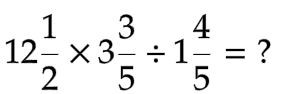
Question:
Solution: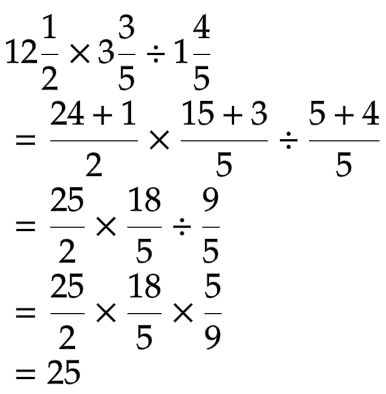
১৮) Three bells ring at intervals of 10 sec, 12 sec, and 15 sec respectively. If they start ringing together, how many times will they ring together in 5 hours?
- 300
- 299
- 302
- 301
Question: Three bells ring at intervals of 10 sec, 12 sec, and 15 sec respectively. If they start ringing together, how many times will they ring together in 5 hours?
Solution:
Given that,
Three bells ringing timing is 10 sec, 12 sec, and 15 sec
Now we have to take LCM of time interval ⇒ LCM of (10, 12, 15) = 60
Total seconds in 5 hours = 5 × 3600 = 18000
Number of times bell rings = 18000/60
⇒ Number of times bell rings = 300
If Three bells ring together in starting ⇒ 300 + 1
∴ The bell ringing 301 times in 5 hours.
Note: The bells start tolling together, the first toll also needs to be counted, that is the number of times of tolling since the first time.
১৯) Find the sum of two positive integers whose product is 200 and whose difference is minimum.
- 33
- 30
- 45
- 54
Question: Find the sum of two positive integers whose product is 200 and whose difference is minimum.
Solution:
Let, x and y be the two positive integer numbers.
Given that,
x × y = 200 and x - y = minimum.
So, the factor pairs are (1, 200), (2, 100), (4, 50), (5, 40), (8, 25) and (10, 20).
The only pair which satisfy both the condition is 10, 20.
And among all factor pairs, (10, 20) has the minimum difference.
Hence, their sum is = 10 + 20 = 30.
২০) Which of the following number is divisible by 9?
- 234561
- 444123
- 555231
- 65422
Question: Which of the following number is divisible by 9?
Solution:
We know,
A number will be divisible by 9 if the sum of the digits of the number is divisible by 9
Sum of digits of 234561 = 2 + 3 + 4 + 5 + 6 + 1 = 21, Not Divisible by 9
Sum of digits of 444123 = 4 + 4 + 4 + 1 + 2 + 3 = 18, Divisible by 9
∴ 444123 is divisible by 9
Sum of digits of 555231 = 5 + 5 + 5 + 2 + 3 + 1 = 21, Not Divisible by 9
Sum of digits of 65422 = 6 + 5 + 4 + 2 + 2 = 19, Not Divisible by 9
২১) Find the sum of the numbers between 550 and 700 such that when they are divided by 12, 16 and 24, leave remainder 5 in each case.
- 1887
- 1980
- 1860
- 1867
Question: Find the sum of the numbers between 550 and 700 such that when they are divided by 12, 16 and 24, leave remainder 5 in each case.
Solution:
Given that,
The number between 550 and 700 such that when they are divided by 12, 16, and 24, leave the remainder 5 in each case.
∴ LCM of 12, 16, and 24 = 48
Multiple of 48 bigger than 550 which leaves remainder 5 are,
1st Number = 48 × 12 + 5 = 581
2nd Number = 48 × 13 + 5 = 629
3rd Number = 48 × 14 + 5 = 677
∴ Sum of these numbers are = 581 + 629 + 677 = 1887
Hence, The sum of the numbers are 1887.
২২) Which of the following is the largest?
- 7/10
- 8/12
- 5/8
- 11/15
Question: Which of the following is the largest?
Solution:
ক) 7/10 = 0.70
খ) 8/12 = 0.667
গ) 5/8 = 0.625
ঘ) 11/15 = 0.733
So, the largest number is 11/15.
২৩) If a is odd and b is even, which expression is even?
- a + b
- ab
- a + 2b + 1
- Both খ and গ
Question: If a is odd and b is even, which expression is even?
Solution:
We know,
Odd + Even = Odd
And Odd × Even = Even
Now, let a = 3 and b = 4
ক) a + b = 3 + 4 = 7 ; Odd
খ) ab = 3 × 4 = 12 ; Even
গ) a + 2b + 1 = 3 + 2 × 4 + 1 = 4 + 8 = 12 ; Even
So, correct answer is Both খ and গ
২৪) The LCM and HCF of two numbers is 585 and 13 respectively. Find the difference between the numbers.
- 39
- 52
- 71
- 67
Question: The LCM and HCF of two numbers is 585 and 13 respectively. Find the difference between the numbers.
Solution:
Given that,
LCM of numbers = 585
HCF of numbers = 13
Let the number be 13a and 13b where a and b are co-prime.
∴ LCM of 13a and 13b = 13ab
According to question,
13ab = 585
⇒ ab = 585/13
⇒ ab = 45
⇒ ab = 5 × 9
Here, a = 5 and b = 9 or a = 9 and b = 5
∴ First number = 13a = 13 × 5 = 65
And second number = 13b = 13 × 9 = 117
∴ Required difference = 117 - 65 = 52
২৫) The least number by which 180 must be multiplied to make it a perfect square is:
- 3
- 4
- 7
- 5
Question: The least number by which 180 must be multiplied to make it a perfect square is:
Solution:
Prime factorization of 180 = 2 × 2 × 3 × 3 × 5
= 22 × 32 × 51
For a number to be a perfect square, every exponent in the prime factorization must be even.
22 ; even power
32 ; even power
51 ; odd power
The only odd exponent is 5. To make it even, multiply by 5.
= 180 × 5
= 900
= 302
So the least number by which 180 must be multiplied to make it a perfect square is 5